
How to optimize a blog post for seo
Introduction
When people start writing blogs, they mainly focus on finishing the blog content. They spend most of their time doing research, planning the structure, and executing it.
But after several blogs, they realised that their blog posts were not appearing in Google Search Results. And also results in low traffic. They will be frustrated.
It is simple. Because they are not optimizing the blog for SEO, that’s one of the reasons their blogs were not ranking in the SERP.
When you write an article, you must follow certain rules that are understandable by Google Search Engines. For example, if the blog must be optimized for SEO, it should have keyword placement, structured headings, and content, as well as internal linking. These are the factors that are required to rank in Google.
I believed that writing more blogs would be sufficient to rank in the search results. Until I have learned about SEO. After implementing practically, I came to know that having long articles was not enough; the blogs had to be optimized properly.
So, in this blog, you’ll learn how to optimize a blog post for SEO step by step, which mainly helps beginners.
And you can understand how to create a seo-friendly blog that can rank on Google Search Engines.
The real problem beginners face with blog seo
Many beginner bloggers publish articles without following a structured SEO process.
Some common mistakes include:
- Writing blogs without proper keyword research
- Ignoring heading structure
- Missing internal links
- Not optimizing images
- Forgetting meta descriptions
By making the above mistakes, search engines may find it difficult to understand the context of the particular blog post.
If you are currently in a learning phase, before writing any blog, you must learn how to do SEO keyword research for beginners. This will help you find out what people are actually searching for.
After finding the right keywords, you can plan and optimize blog posts related to the keywords properly.
Why blog post seo optimization matters
As I said earlier, optimizing the blog post will help the Google Search Engines understand the context of the blog post.
Here are some important benefits of SEO blog optimization.
Better Search Visibility
When your blog content is optimized for specific search intent, the search engines understand the context of your article. It can appear in the various search results.
Improved User Experience
To enhance the user experience of readers viewing the blog, the article must be optimized well by addressing specific search intent, heading structure, content structure, and linking the blog to relevant articles.
Higher Ranking Potential
SEO optimization increases the chances of ranking for multiple related keywords.
How to optimize a blog post for SEO (STEP-BY-STEP GUIDE)
FIND & CHOOSE THE RIGHT KEYWORD
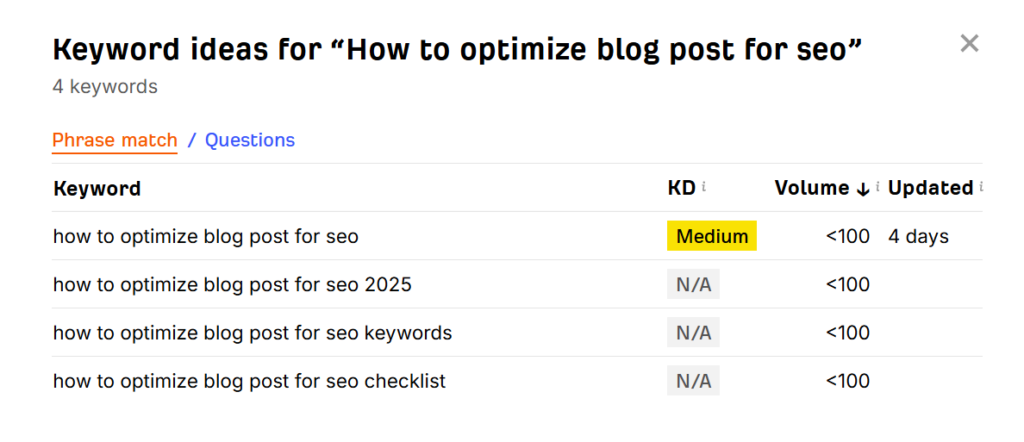
The most vital process for blog optimization is to find and select the right keywords for your blog. And that has to be your primary keyword.
For choosing the primary keyword, you can use keyword research tools.
Check whether the primary keyword has more search volume. The more the search volume, the more people also search on Google.
Keywords are the main ingredient for blogs that search engines understand your blog content. Without the keyword, your blog can’t rank in the search engine, and it lacks intent.
Optimize the blog title
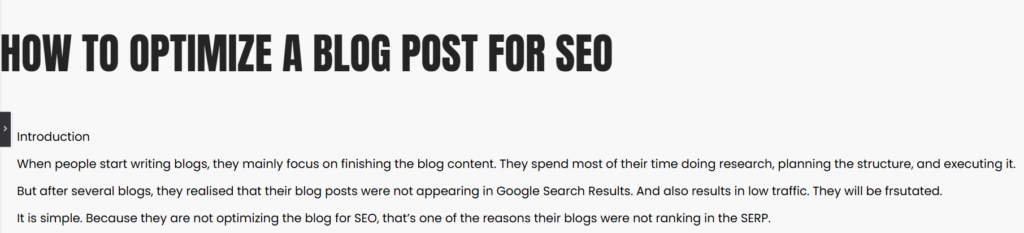
The primary keyword has to be added naturally to your blog title.
Example:
Bad title:
Blog Optimization Guide
Optimized title:
How to optimize a blog post for seo
Search engines give strong importance to the title to understand the content of the page.
write an seo friendly url
The URL of the blog has to be short and precise. Not long, and it should include the primary keyword.
Example: optimize-blog-post-for-seo
The character limit can be 60-75, which works better for the URL. Avoid long characters more than 75.
It will be easier for search engines and users to read if the URL is short.
Use proper heading structure
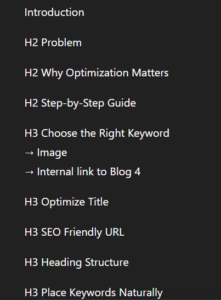
Headings will help organise your blog content.
Use a clear structure such as:
- H1 – Main topic
- H2 – Major sections
- H3 – Subsections
A well-structured heading hierarchy really helps both the blog’s readability and SEO.
Place keywords naturally
Your primary keyword should appear naturally in important places such as:
- Blog title
- First paragraph
- Headings
- Meta description
- Image alt text
And don’t add too many keywords, not more than 2-3% keyword density.
When optimized properly, one article can even rank for multiple keywords in search results.
Optimize images
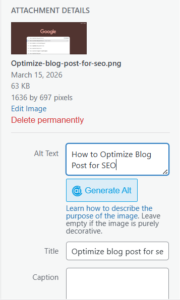
Images improve engagement and readability.
To optimize images for SEO:
- Use descriptive file names – Can use focus keyword
- Add alt text
- Compress image size – under 2 MB
Optimizing images can help search engines understand the visual content of your blog.
Add internal links

An internal link is nothing but connecting one blog to another by pasting the particular article link in the form of anchor text.
For example, on my website, there is a blog related to the WordPress on-page SEO checklist. The article was about the steps to follow for onpage SEO.
I can give an internal link to this blog, connecting to my older blog. Both are connected to optimize a particular article.
And most importantly, the internal link should be in a Anchor text. With the help of internal links, search engines can discover pages and improve topical authority.
Improve readability
The blog content should be simple and understandable by the audience and search engines.
You can improve readability by:
- Using short paragraphs
- Adding bullet points
- Using simple language
- Breaking long sections into headings
Good readability improves user experience and engagement.
Common blog seo mistakes beginners make
Many people unintentionally make mistakes while writing blogs, and they don’t even realise their mistakes. It affects the blog content and also the rankings on the results page.
The mistakes include:
- Keyword stuffing – will lead to a Black hat strategy
- Missing internal links – One of the onpage SEO element
- Poor heading structure – Onpage SEO element
- Ignoring meta description – Important for CTR and SEO optimization
- Publishing without SEO optimization – Affects ranking and visibility
These are the mistakes that affect your blog’s performance.
Quick blog seo optimization checklist
If you are a beginner to writing blogs, check these before publishing them on your website:
- Keyword research completed
- Blog title optimized
- SEO friendly URL created
- Heading structure organized
- Images optimized
- Internal links added
- Meta description written
These can help you optimize a blog post so that search engines understand better.
Frequently asked questions
How do you optimize a blog post for SEO?
Choose the primary keyword, check whether it is answering the informational intent, plan the blog structure around the intent, add internal links, and optimize the images using alt text, etc.
What makes a blog SEO friendly?
The blog needs to follow the onpage SEO elements. If you are using the RankMath plugin or any other SEO plugin, it will be easier for you to follow the SEO onpage elements.
Where should keywords be placed in a blog?
The primary keyword should be placed in the blog title and also in H2 of the blog, at the beginning of the content, image alt text, meta title, URL and description.
How many keywords should a blog post have?
One primary keyword, secondary keywords can have upto five, and semantically relevant keywords can be derived from People also ask. These keywords can be used inside the blogs naturally.
What are the common blog SEO mistakes?
Stuffing keywords, avoiding internal linking of relevant blogs, bad content quality structure, and ignoring on-page SEO elements.
Conclusion
To rank your content on the website, writing blogs is the initial step. Only blogs cannot make you rank in the top; the on-page, technical, and off-page SEO optimization has to be done. That has to be improved consistently to rank at the top of the search engine results page.
The ranking factor can be improved by going through the process of seo optimization.
SEO is not only about keywords, but it is also about EEAT – Experience, Expertise, Authoritativeness, Trustworthiness.
This is the main framework that google uses to evaluate content for ranking in the results page.
Before writing a blog, apply these SEO optimization techniques consistently, and by doing this, your website can gradually build authority and attract more organic traffic.