
How to improve CTR in seo (beginner guide)
Introduction
At first, I thought ranking on Google was the hard part.
But I was wrong.
Getting clicks on Google was the hardest part. That I have realized later. My blogs were ranking on Google, but it was not getting enough traffic.
So that’s the key lesson I learned: ranking in Google doesn’t get you clicks.
That’s the reason I have started to analyze CTR.
With just a minimum number of clicks across my website. I knew I didn’t have massive data. But instead of waiting for perfect numbers, I decided to treat this as a real learning opportunity to understand why users weren’t clicking and what I could actually do to improve it.
I’ll walk you through:
- How I identified low CTR using real data.
- The exact mistakes that were affecting my clicks
- Practical fixes I started implementing
- And what every beginner should focus on to improve CTR in SEO
If you ever wondered why your blog isn’t getting clicks even when it’s ranking, this will give you a clear, practical direction.
If you want to understand how my blog started ranking in the first place, you can check this real SEO case study for beginners where I explained the complete strategy I used.
Why your ctr is low even if you rank
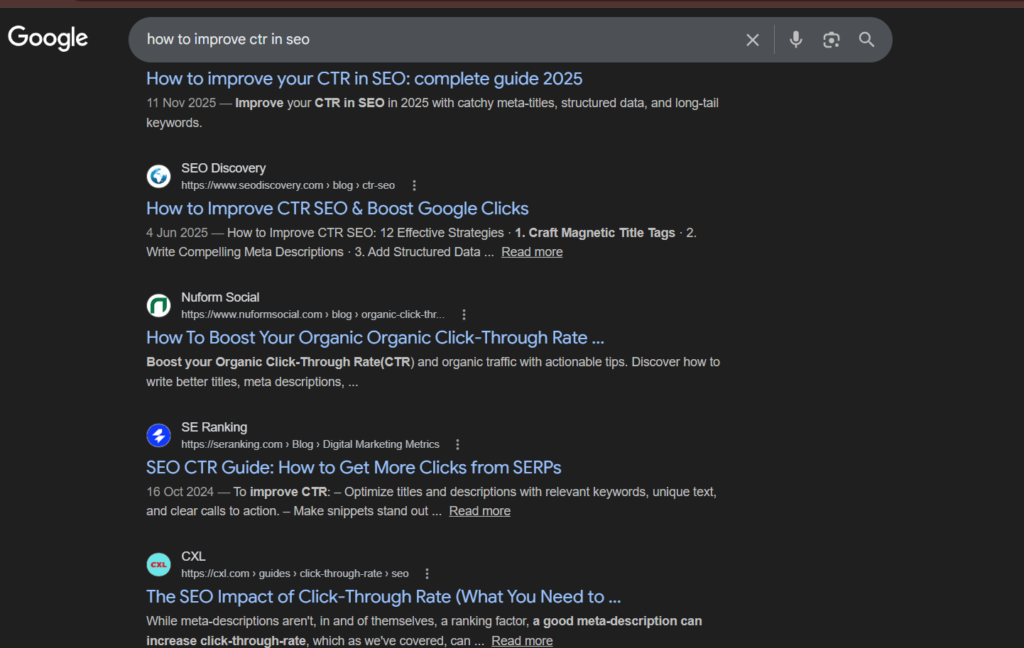
One of the biggest misconceptions beginners have in SEO is this:
If I try to rank my blog, then the clicks will follow too.
But it is not how it works.
You can be ranking on the first page and still get very few clicks.
This is the problem I have been facing currently.
When my blog started appearing in the serp, the clicks were not expected as they were compared to impressions.
So I realized that:
Being visible does not give you traffic.
I’ll explain why it happens:
- Your title was not unique compared to the competitors
- Your meta description doesn’t give a strong reason to click
- Your content doesn’t fully match what the user is looking for
- Your result looks similar to every other blog on the page
From the perspective of the user, your blog is just not the only option. If it doesn’t help them to solve their problem, they will skip your blog.
This is one of the most common CTR mistakes beginners make.
They only focus on how to rank their content, not to prioritize clicks.
That’s what really has to be fixed.
Before I ask myself How to rank in the top?
And now I started asking Why would someone have to click my content?
That shift in thinking is what led me to start understanding and improving CTR in SEO.
Why you can trust this article
This is not just a theoretical or copied from different websites.
It is based on real data that refers to my website.
It is not a high authority domain, nor does it have more quality backlinks. The truth is, my website is still in an early stage with a limited amount of traffic and few clicks.
And that’s exactly why this case study matters.
Because everything I’m sharing here is
- Based on my real implementation
- Observed through actual performance data
- Learned through trial, error, and testing
There are no assumptions or perfect scenarios
Instead, this is a beginner-level breakdown
- What if your blog has impressions but no clicks
- How can you find the specific problem
- What do you want to improve immediately
If you are just starting with SEO, this will be relatable because it is a real challenge every beginners face.
And the main point is:
You don’t need huge traffic to start learning and improving SEO.
What is ctr in seo (and why it matters)
CTR in SEO refers to the percentage of people who have clicked on your website in the search results.
CTR means Clicks / Impressions * 100
For example, if your blog appears in the search results 100 times and it gets 5 clicks, then your CTR is 5%.
Why CTR matters in SEO?
Because CTR indicates how strong your content might be in search results.
Even when your blog is ranking, a low CTR means that:
- Users are not interested in clicking your result
- Your title or meta description is not compelling enough
- Your content may not match the search intent
On the flip side, a higher CTR means:
The result of your content is relevant and also useful to the audience.
This can indirectly improve your rankings over time.
That’s why understanding and improving CTR in SEO is not optional; it’s essential if you want to turn impressions into actual traffic.
If you’re new to this concept, it’s important to first understand what is keyword research in SEO and how user intent plays a major role in getting clicks.
How i identified the problem using google search console
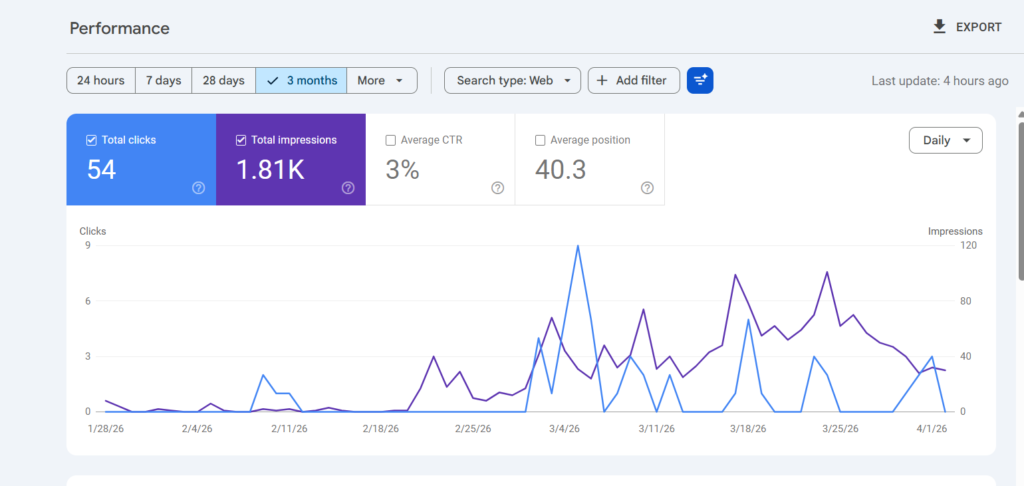
First, my blog was getting good impressions, and then I noticed that something was missing: clicks.
So I navigate to Google Search Console.
Then I understood what happened.
When I checked the performance data, I saw something important:
My blog pages have consistently had impressions. Except for the clicks.
This clearly shows me one thing:
The problem is not about visibility; it is about CTR.
In simple terms:
- Google was ranking my content
- But users are not engaging with it
Many people will ignore this:
When your content manages to get more impressions but not clicks, it depicts:
Your content is being discovered, but not chosen.
And that’s when the CTR comes into the picture.
Using Google Search Console, I was able to:
- Identify which page has low CTR
- Compare impressions vs clicks
- Understand which keywords were triggering my pages.
This helped me to prioritize ranking to:
Making my content to get more clicks in search results.
Because at the end of the day, impressions don’t bring traffic, clicks do.
This is also relates to how a single blog can appear for different queries, which I’ve explained in detail in this post on can one blog rank for multiple keywords.
Why ctr is low (real reasons from my analysis)
I found out that CTR was the problem, the next step for me to understand that:
Why are people not clicking on my blog when it is showing on Google?
After analyzing my blog and also a few other blogs in the serp. I found out the reasons.
Weak or generic titles
My title was too generic and very simple.
The title has to be unique and stand out compared to the competitors.
The title must not only contain the keywords but also the reason to click on it.
No curiosity or clear benefit
I found out that my titles and descriptions are not creating interest or curiosity.
From a user’s perspective:
“ Why should I click this result instead of others?”
If this question is ot addressed instantly, the user will scroll up to other results.
not fully matching search intent
The content has to match the user’s search intent. Only keywords without clear search intent will not help to rank.
For example:
If users are looking for practical solutions, but your title sounds like a basic explanation, they may skip it.
This mismatch between content and intent reduces CTR.
weak or missing meta descriptions
In some cases, I didn’t pay much attention to meta descriptions.
But in serp it is like a short preview that users can understand what the content is about.
If it’s not clear, compelling, or relevant:
Users don’t feel confident about clicking your page. Too similar to competitors
When I compared my content with that of other competitors’ content that is appearing in the results page. I noticed that:
Everything looks almost the same
Same titles
Same wordings
Users chose the results that look interesting to them.
All these issues put together in one big problem:
Low CTR when my content is ranking.
And I realized that improving CTR is not fixing one thing; it is about resolving multiple factors that influence the user decisions.
How to improve ctr in seo (practical fixes that i applied)
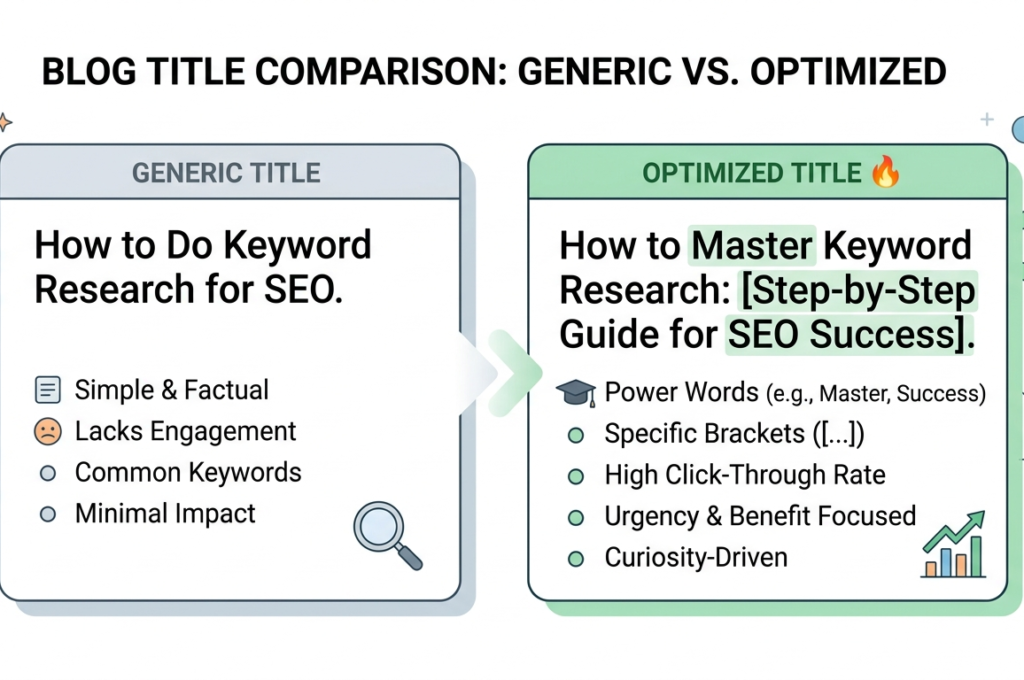
rewrite titles for clicks (Not just keywords)
Earlier, my titles were keyword- focused but not click-focused.
So I started rewriting them to:
- Include a clear benefit
- Create curiosity
- Stand out from other results.
For example, instead of writing a plain title, I added elements like:
- “Beginner’s guide”
- “Real Case Study”
- “Practical Fixes”
This made my titles more appealing and increased the chances of getting clicks.
optimize meta descriptions like ad copy
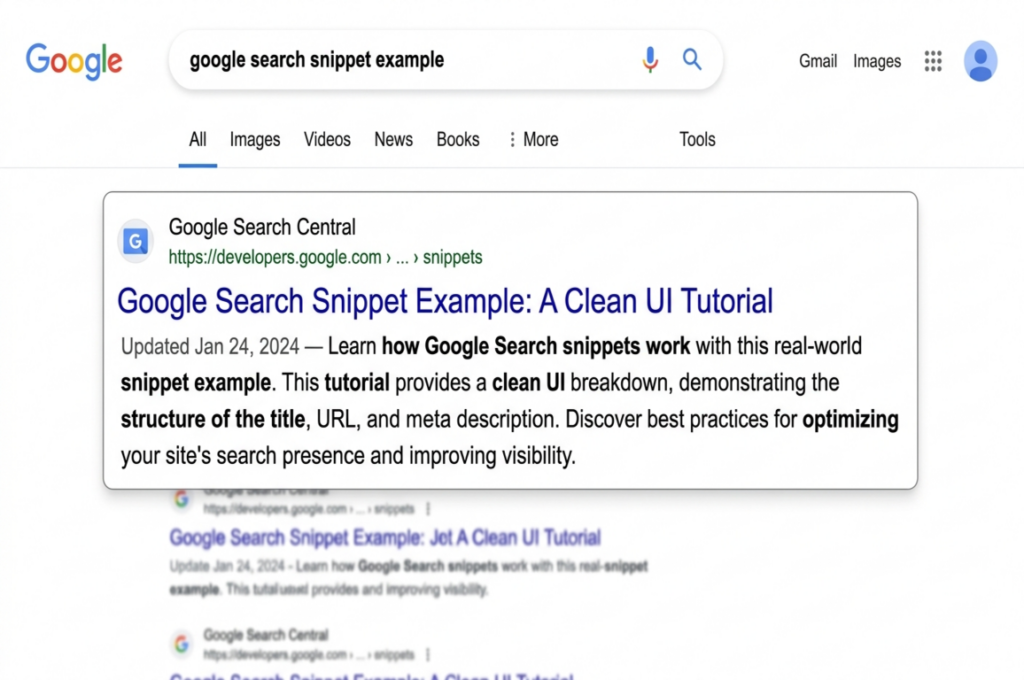
I realized that meta descriptions act like a short pitch to the user.
So instead of leaving them basic, I started:
- Clearly explaining what the user will learn
- Adding a simple call-to-action
- Aligning it with the search intent
A good meta description gives users a reason to click, not just information.
Match search intent properly
This was one of the biggest improvements.
Before, I was focusing on keywords.
Now, I started focusing on:
What exactly the user wants when they search this query
If the intent is to find solutions, my title and descriptions should clearly reflect that.
This alignment helps users instantly recognize that your content is relevant.
use numbers, brackets, and power words
To make my result stand out visually, I started using:
- Numbers (like 5 ways, 7 steps)
- Brackets (like [Guide], [Case Study])
- Power words (like Easy, Proven, Practical)
These small additions improve visibility and attract attention in search results.
focus on long-tail keywords
Focusing on long-tail keywords helps rank faster.
These keywords usually have:
- Lower competition
- Clearer intent
- Higher chances of getting clicks
use of google search console for continuous improvement
CTR optimization is not a one-time task.
So I started using Google Search Console to:
- Identify pages with deep impressions but low CTR
- Update titles and meta descriptions
- Track performance over time
This helped me treat CTR improvement as an ongoing process rather than a one-time fix.
These can seem like simple changes, but when combined, they can create a significant impact on your content.
what results did i start to see
I didn’t expect quick results after making those changes.
But I started to see something important. Instead of expecting the content to rank in Google, I focused on content performance in terms of clicks.
Gradually, I could see:
- Better alignment between my titles and search intent
- Clearer positioning of my content in search results
- Improved understanding of what makes users click
I’m focused on improving my approach rather than focusing on how to get more clicks.
I was no longer guessing
By analyzing the actual available data, testing, and improving.
This shift in mindset is what matters the most in the early stages of SEO.
Because CTR improvement is not about instant results, it is about:
- Continuous testing
- Small optimizations
- And learning from actual performance.
common ctr mistakes to avoid
Keyword stuffing in titles
Adding more keywords in the title will look unnatural and confusing.
The users may find it annoying.
Misleading or clickbait titles
Using unwanted titles to increase the clicks is not fair.
Users will leave the page. It will affect the bounce rate of the website.
Ignoring meta descriptions
Meta descriptions can convince users to click on the content.
But many users forgot to create a meta description.
Not Matching search intent
The search intent is very crucial; even if your content is well written, it doesn’t match the user query. It will not rank.
More than keywords, understanding the intent is more important.
Using the same structure as everyone else
There is no point in copying the same title and description as others on the results page.
Standing out from others is what makes CTR achievable.
Avoiding these can improve your CTR in the same rankings.
In fact, many of these issues come from the same problems discussed in this guide on common keyword research mistakes beginners make, where I break down why most blogs fail to perform.
key learnings
Ranking Alone is not enough
Ranking on Google will not give you clicks. Only CTR can create traffic for your website.
Small changes can make a big difference
CTR requires only minimal changes. Like:
- Rewriting titles
- Improving meta descriptions
- Aligning with intent
These can significantly impact the performance over time.
Search intent matters more than keywords
Targeting the right keyword is important.
But understanding why the user is searching is what really drives clicks.
Intent alignment = better CTR.
CTR optimization is an ongoing process
It is not about fixing one time and then being finished.
You have to:
- Test different titles
- Analyze performance
- Keep improving
SEO is about consistency.
Beginners Can Improve CTR Without Authority
It doesn’t have to be the way in which you need to have a high domain authority and more backlinks website to start improving CTR.
Even a small website can get better results, but the website has to be optimized well.
what i'll do next
CTR is a never-ending process. Need to improve CTR from time to time.
I’m planning to do these things from what I have learned:
- Try different title variations for more clicks
- Improve meta descriptions for better clarity and engagement
- Monitor performance regularly using Google Search Console
- Update existing content based on user behavior and data
- Gradually build backlinks to strengthen overall SEO performance.
The goal is simple: Continuously improve my content and ensure it appears in the search results and performs well.
conclusion
SEO is not only about rankings but also about getting clicks.
Your website can have more impressions, visibility, and even first-page rankings…
But clicks what defines your traffic
By focusing on:
- Writing better titles
- Optimizing meta descriptions
- Matching search intent
- And continuously improving based on data
You can turn impressions to your website into clicks
frequently asked questions
How do you improve CTR in SEO?
Optimize the title tag, meta descriptions, matching the user intent, using power words, structured schema, and making the content unique to stand out from competitors.
How to fix low CTR in SEO?
Identify the pages that have high impressions and low clicks, and then optimize the titles, meta descriptions, and ensure the content matches the user intent.
Does CTR affect SEO rankings?
No, CTR is not a direct ranking factor, but it helps in sending user engagement signals to Google.
What is a good CTR for SEO?
Good CTR may differ based on position and niche. But a higher CTR compared to your average performance is considered positive.
Why is my CTR low in Google Search results?
It might be because of weak titles and descriptions, not matching the user intent, irrelevant content, etc.