
SEO Case study for beginners: how i ranked a blog on page 1 in 24 hours
Introduction
On Monday morning, after a long session of writing a blog, I finally posted it. The same day, after 8 hours, I was shocked by the result.
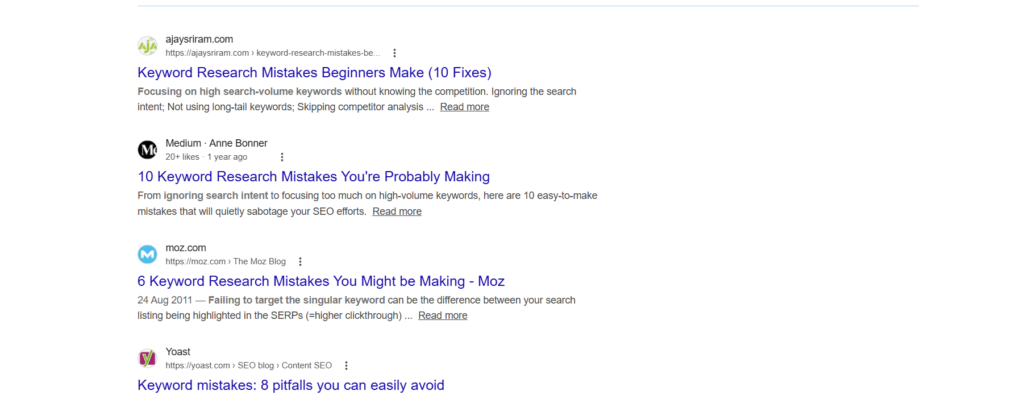
The blog I published on Monday morning was ranking on the first page in 2nd position. I couldn’t believe it. I also searched for that keyword in Incognito mode.
Then from another account. And even from my phone, just to make sure it wasn’t personalized.
But the result was the same.
My blog targeting Keyword research mistakes beginners make was ranking on page 1.
For a beginner website with low authority, no backlinks, and just a few blogs, this was unexpected.
So naturally, one question came to my mind:
How did this actually happen?
In this SEO case study for beginners, I’ll break down:
- How I ranked a blog on Google
- The exact keyword and content strategy I used
- Why the ranking fluctuated after initial success
- And what this means for beginners trying to rank fast
If you’ve ever wondered how to rank a blog fast in SEO, this real example will give you clarity.
The problem : why most beginner blogs don't rank
Before this experiment, I faced the same problem most beginners face:
- Writing blogs but not getting traffic
- Targeting keywords that were too competitive
- Not fully understanding search intent
Like many beginners, I initially thought:
“If I write good content, it will rank. ”
But that’s not how SEO works.
The reality is:
Even good content won’t rank if the keyword strategy and intent are wrong.
This is where most beginner SEO efforts fail.
Why you can trust this case study
This is not a theoretical guide or a rehash of existing concepts.
This is a real blog ranking case study
- Executed on a new website
- Without backlinks
- Without domain authority
Everything shared here is based on:
- Actual implementation
- Real observations
- Real ranking behavior
Keyword strategy I used (The turning point)

Instead of targeting broad keywords like:
- “SEO tips”
- “keyword research”
I focused on:
“Keyword research mistakes beginners make.”
This decision changed everything.
Why this keyword worked
- It had a clear beginner’s intent
- Lower competition compared to broad keywords
- Specific problem-solving query
This is a classic example of:
Long-tail keyword strategy for beginners
Intent over volume
Instead of chasing high search volume, I focused on:
What exactly does the user want
When I analyzed the SERP, I noticed:
- Users were looking for mistakes
- But also wanted solutions and clarity.
This helped me align content with intent, which is critical in any SEO case study example.
Content strategy (serp analysis & content gap)

What i found
Most blogs:
- Listed mistakes
- Gave basic explanations
- Lacked actionable fixes
The gap
The gap wasn’t in “topics.”
It was in “execution.”
Users needed:
- Simple explanations
- Real examples
- Clear solutions
My approach
So I structured my content like this:
Mistake → Why it happens → Example → Fix
This made the blog:
- More practical
- Easier to understand
- More useful
On-page seo & internal linking
On-page seo
- Primary keyword in title and intro
- Clean heading structure
- Natural keyword usage
I didn’t over-optimize.
I focused on clarity.
Internal linking strategy
I linked the blog to related content:
This helped:
- Improve topical authority
- Increase crawlability
- Enhance user experience.
What happened after publishing
After publishing, I didn’t expect immediate results.
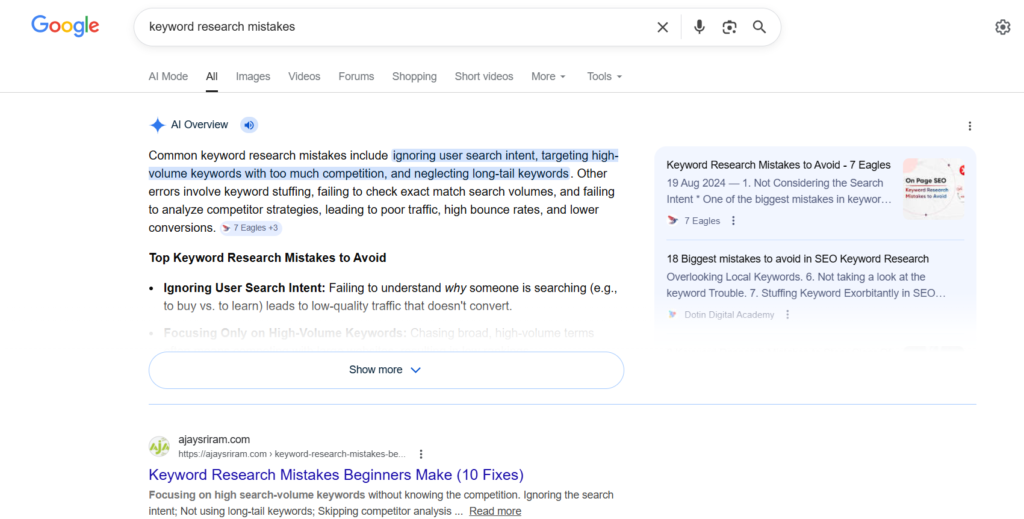
I went to class, made notes, and then suddenly, after the lunch break. I’ve been thinking of searching the blog to check whether it was indexed or not. And when I searched for that blog keyword. I couldn’t believe that it was ranking on the first page of Google.
To confirm, I:
- Checked in incognito mode
- Used different accounts
- Tested on multiple devices
It was also ranking for broader queries like:
keyword research mistakes
why rankings fluctuate (understanding google behavior)
google testing phase
When new content is published, Google tests it by:
- Temporarily boosting visibility
- Observing user interaction
role of ctr (click-through rate)
If users:
- Click your result → positive signal
- Ignore it → negative signal
Engagement signals
Google also tracks:
- Time on page
- Bounce rate
- User behavior
This explains:
Why do blog rankings fluctuate in SEO.
THE LESSON TO LEARN FROM THIS SEO CASE STUDY
FOCUS ON LONG-TAIL KEYWORDS
Targeting specific queries increases ranking chances.
The search intent matters rather than volume
Understanding user intent is more important than keyword volume.
well-structured content is important
The content you are writing has to be readable and must also increase user engagement.
Fresh content can rank fast
Yes, fresh content can rank quickly.
But it depends on performance signals.
Authority is not necessary at the beginning
With the right strategy and procedure ranking your content is possible without many backlinks.
what i'll do next
To improve and stabilize rankings:
- Optimize CTR
- Monitor Google Search Console
- Build backlinks
- Update content based on data
Conclusion
This SEO case study for beginners proves one important thing:
Ranking is not just about content, it’s about strategy.
By:
- Choosing the right keyword
- Understanding intent
- Structuring content properly
Even a beginner can achieve early rankings.
However, long-term success depends on:
- User engagement
- Consistency
- Continuous optimization
This also serves as a practical SEO case study example for beginners.
frequently asked questions
how long does seo take to rank?
From weeks to months, it is not a one-time job; it requires patience. And it’s a compounding effect.
why does blog ranking fluctuate?
Google tests new content based on CTR, engagement, and user behavior.
Does fresh content rank faster?
Yes, fresh content can temporarily boost ranking, but it needs performance signals to stay.
How does google rank new content?
The content needs to match the user intent and also the relevance. EEAT also plays a major role in content ranking.
what is the google freshness algorithm?
It prioritizes recently published or updated content for queries where freshness matters.