
Keyword research mistakes beginners make (And how to fix them)
Introduction
Do you know why the blog that you are writing is struggling to rank on Google?
What if I say there is a way to fix it?
Sounds interesting?
And yeah, it is possible. People consistently post blogs on their own random method and believe it is actually a good practice. But in the end, they’ll get less traffic.
I have been in the same situation as you before…
When I was in a learning phase, I believed that keyword research is nothing but finding a trending keyword that has high volume, and I would write content and expects it to rank on SERP.
Turns out my content doesn’t rank in the SERP and I have failed miserably.
My content didn’t receive any clicks, impression, or reach. And then I realized the mistake I had made while doing keyword research .
Keyword research is not just about finding keywords; it’s about understanding what the intent is all about.
Targeting high-competition keywords with more volume, KD, and ignoring the user intent were mistakes that cause your content to be invisible on Google.
In this guide, I’ll walk you through the most common keyword research mistakes beginners make. With simple and practical ways to fix each one.
And you would have the confidence and clarity on how to do keyword research properly, without making any errors.
what is keyword research and why it matters in seo
First, let me tell you something before we discuss the mistakes:
What exactly is keyword research?
In simple words, keyword research is the process of finding words or phrases that users search in the search bar on Google. If they want to know something, buy something, or compare the products or the services.
For example, if someone types “How to gain weight” or “Best smartphone under 20000”.
Here’s where most of the beginners go wrong, and they think they have found the best keywords. These are just keywords.
The actual keyword research is about understanding what people are searching for, why they are searching for it, and how difficult it is to rank for it.
This is the place where search intent plays a pivotal role in helping your content rank or not.
If you are new to this concept, you can check out my detailed guide on SEO keyword research for beginners.
why keyword research is more than just keywords
Beginners who are into SEO believe that including a keyword will help to rank on Google.
But SEO doesn’t work like that anymore.
Google’s algorithm has been updated now.
It mainly focuses on:
- What the user actually wants
- Whether your content answers that need
- How useful is your content compared to others
So, choose the keyword and understand intent, and then start writing content for a better output.
What happens when you get keyword research wrong
This is the place where most people struggle
You might:
- Target keywords that are too competitive
- Choose keywords with the wrong intent
- Attract the wrong audience
- Even worse, no traffic
So, even a well-written blog can fail if the keyword strategy is wrong.
Why this matters for beginners
Since your website is new, you start with a low domain authority.
You cannot directly compete with a high authority website.
For example, you can start learning new skills, but you cannot challenge an expert who has already mastered that skill.
That’s why strategic keyword selection comes into play.
- The right keyword can bring traffic
- A wrong keyword will test your patience and will not help in ranking.
Key takeaway:
Keyword research is not just about finding words
It’s about:
- Understanding search intent
- Choosing realistic keywords
- Matching your content with what users actually want
And this is exactly the part where most beginners make mistakes.
10 keyword research mistakes beginners make (and how to fix them)
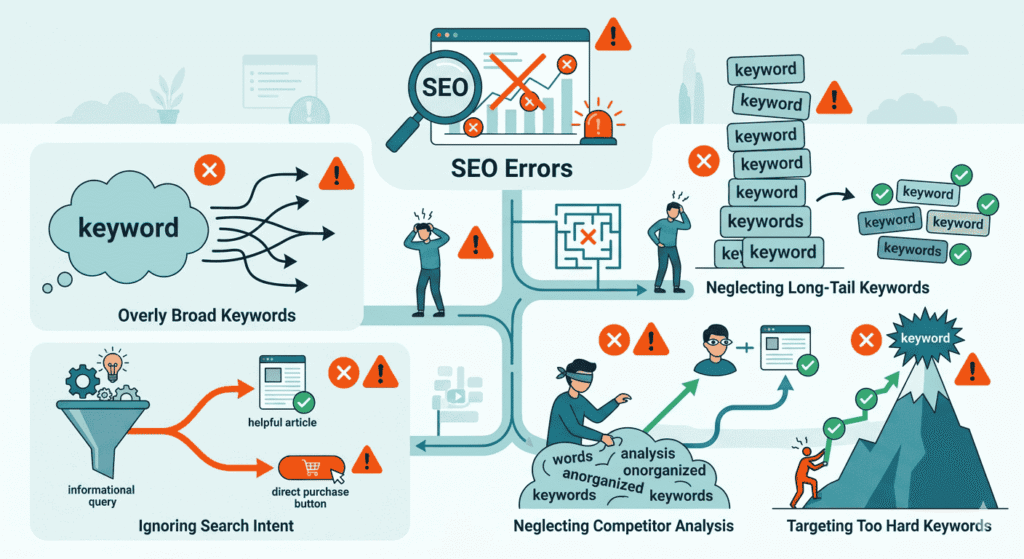
targeting only high-volume keywords
The mistake
Most of them believe that if the keyword has more search volume, it means they can get more traffic.
So they go after keywords like:
- SEO
- Digital marketing
- Weight loss
These keywords look attractive because thousands of people search for them.
Why does it happen
The majority of SEO tools mainly highlight search volume of the keyword, and people thought it might be the most important metric to work on.
They ignore:
- Competition
- Authority
- Ranking difficulty
Example
Let’s say you write a blog targeting:
“SEO tips”
You’ll be competing with:
- Big agencies
- Established blogs
- High-authority websites
As your website is new, your chances of ranking in Google might be low compared to big brands.
How to fix it
Instead of choosing highly competitive keywords, focus on long tail keywords that could have lower competition.
For example:
- SEO tips
- SEO tips for beginners in 2026 – Long-tail keyword
These keywords:
- Have lower competition
- Match specific intent
- Are easier to rank
For a new website, it’s best to target 100-300 monthly searches rather than chasing a 10,000 searches that will never be reached.
Ignoring search intent

The mistake
You might have chosen the keyword, but it will not match what the user is actually searching for.
Why does it happen
Because beginners only focus on the keyword and its volume, they remain careless about the intent of the keyword.
Example
Keyword: “best SEO tools.”
User intent: wants a list of tools
Your blog: It will explain what SEO tools are about, how it works, etc.
Result: It won’t rank
How to Fix It
Before writing:
Whatever the keyword might be, search on Google and check the results.
- What type of content is ranking?
- List? Guide? Comparison?
According to the results, you can plan your content.
Once you understand intent, the next step is optimizing your content properly. Here’s a guide on how to optimize a blog post for SEO.
not using long-tail keywords
The mistake
Only targeting the short, highly competitive, more KD, and generic keywords.
Why does it happen
Short keywords are more powerful and popular.
Example:
Keyword research – short tail
Keyword research for beginners step by step – long-tail
How to fix it
Focus on:
- specific queries
- beginner-focused phrases
- problem-based keywords
Focus mainly on long-tail keywords, which can help in easier rankings and also better conversions.
Choosing irrelevant keywords
The mistake
Selecting keywords that are not relevant to your audience and also don’t match your content.
Why does it happen
Most of them chase the traffic of keywords, not their relevance.
Example
Writing about SEO but targeting:
“Instagram growth hacks.”
You can get traffic, but it won’t last long because the audience finds it irrelevant.
How to fix it
Ask yourself:
Does this keyword match my content? Will it be relevant to the audience?
If not, skip it.
Not analyzing competitors
The mistake
Writing content without considering the competitor’s content that is already ranking.
Why does it happen
Because beginners believe that their content is best to their knowledge
Example
You wrote an 800-word blog
But competitors have:
- 2000+ words
- examples
- structured content
You won’t rank.
How to Fix It
Before writing:
- Analyze the top 5 results
- Check headings
- Find content gaps
Then create better content.
ignoring keyword difficulty
The mistake
Finding and using keywords that are very hard to rank.
Why does it happen
Because it is difficult for them to understand the keyword difficulty metrics.
Example
Keyword difficulty: 80+
Competing against strong domains
How to Fix It
Start with:
- low to medium difficulty keywords
For the new website, you have to build authority first, and then you can target more KD ones.
keyword stuffing mindset
The mistake
Using the same keyword as many times as possible in the content.
Why does it happen
Still, some of them believe in traditional method of SEO, which is why they are using more keywords
Example
Repeating:
“keyword research mistakes” in every sentence
How to Fix It
Write naturally.
Use:
- variations
- synonyms
- semantic keywords
Place the keywords naturally in the content and don’t repeat too much.
Instead of repeating the same keyword, you can target multiple related keywords naturally in one blog.
Not updating keywords over time
The Mistake
Using the same keywords forever.
Why does it happen
As beginners are new to SEO, they think keyword research is one-time work.
Example
Google mainly prioritizes updated content, so based on recent trends, you need to update your content.
How to fix it
Regularly:
- check Search Console
- update keywords
- optimize content
relying on one tool only
The mistake
Assuming that only one tool gives the best results
Why does It Happen
Beginners trust one platform blindly.
Example
Using only Ubersuggest or only Keyword Planner.
How to Fix It
Use multiple sources:
- Google suggestions
- Search Console
- different tools
This gives better insights.
skipping performance tracking
The mistake
Not monitoring the keywords being used to determine whether they are getting traffic or not.
Why does It Happen
Beginners publish and forget.
Example
You don’t track:
- impressions
- clicks
- rankings
How to Fix It
Use:
- Google Search Console
- Analytics
Track → Learn → Improve
simple keyword research framework for beginners
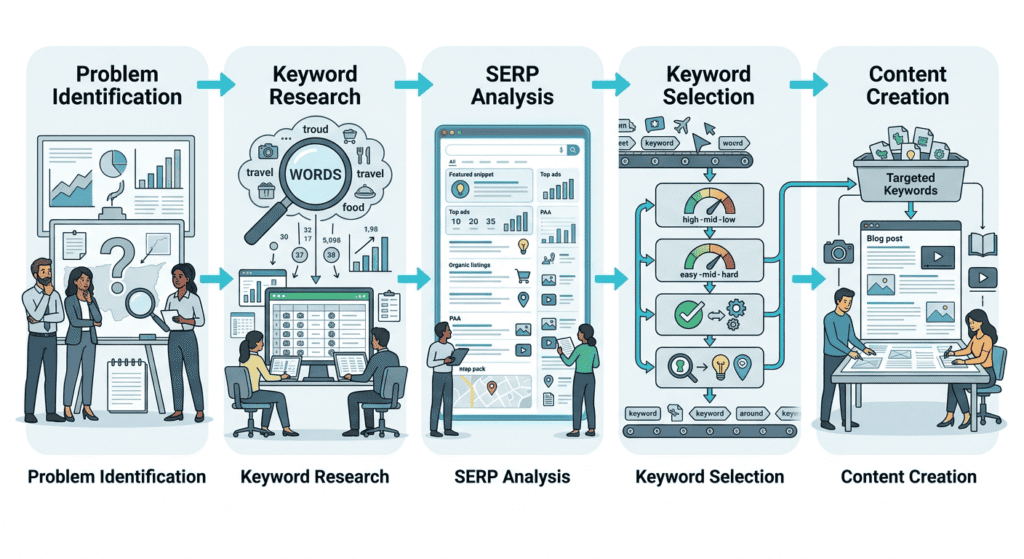
So, now that you know the mistakes to avoid in keyword research, we can focus on how to do it properly.
It is good to know the best practices rather than doing any research.
You can use this simple 5-step keyword research framework for every blog.
step 1 : start with the user's problem
Before opening any tool, ask:
What problem are you trying to solve?
For example:
- “How to optimize a blog post.”
- “Why is my website not ranking?”
This would help you focus on the search intent, not just random keywords.
step 2 : find keyword ideas
Now use tools to expand your idea.
You can use:
- Google autocomplete
- “People Also Ask.”
- Ubersuggest
- Google Keyword Planner
Collect 10–20 related keyword ideas.
step 3 : analyze the serp (important)
Go to Google and type your query in the search bar, and check the results page.
- What type of content is ranking?
- Blog? List? Guide?
- How detailed is the content?
This will help you to know exactly what Google prefers for that particular keyword.
step 4 : choose realistic keywords
Now filter your list:
Ask:
- Can I compete with these websites?
- Is the keyword too broad?
- Does it match my audience?
Pick keywords that are:
- low to medium competition
- specific
- relevant
step 5 : create content that matches intent
This is the main picture
Your content should:
- match the search intent
- solve the problem clearly
- be better than existing results
Key takeaway
Keyword research is not rocket science.
If you follow this process:
- you avoid common mistakes
- You choose better keywords
- You focus on the user intent
frequently asked questions about keyword research
what are the common keyword research mistakes?
The most common keyword research mistakes are:
- Focusing on high search-volume keywords without knowing the competition.
- Ignoring the search intent
- Not using long-tail keywords
- Skipping competitor analysis
- Not tracking performance
These are mistakes you should avoid, and they will prevent your content from ranking.
How to do keyword research correctly?
- Start with a clear topic or problem
- Find keyword ideas using tools
- Analyze search intent
- Check competition and difficulty
- Choose realistic keywords
Following this structured approach will help you to avoid mistakes and can improve rankings.
why is keyword research important in seo?
It is important to know about
- What people are searching for
- What type of content do they expect
- By identifying the keyword to rank for
Your content may not reach the right audience without it.
what is keyword difficulty in seo?
Keyword difficulty is a metric that shows how difficult it is to rank for a particular keyword.
It depends on:
- competition
- domain authority of competitors
- quality of existing content
Focusing on Low-Medium difficulty keywords is the best practice for a new website.
How do beginners choose the right keywords?
Beginners should:
- Focus on long-tail keywords
- Choose the topics that are easier to rank for
- Match the content with search intent
- Analyze the competitors, their content, and their keywords before writing.
This increases the chances of ranking and getting traffic.
conclusion
Keyword research is not just about finding the right words or phrases; it’s about identifying the intent behind them.
People do struggle with seo not because of their lack of effort, but because they make mistakes that they don’t realize early.
Targeting the high-volume keywords while ignoring the search intent also affects your rankings in the future.
But the good part is that if you rectify those mistakes, you can rank better than your competitors.
If you focus on:
- choosing the right keywords
- understanding user intent
- and following a simple strategy
Will significantly improve your rankings.
Start small.
Implement things, keep testing, and try to improve from your mistakes.
Because SEO is not a one-time play, it’s about consistency and patience.